
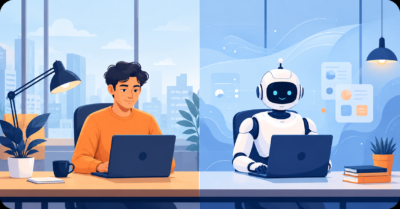
AI vs Human Jobs: Artificial intelligence is no longer a distant, futuristic concept confined to science fiction. By 2026, it has become a visible and unavoidable part of everyday work. Offices, schools, hospitals, studios, factories, and even small local businesses are using AI-powered tools to save time, cut costs, and boost efficiency. As this shift accelerates, one question keeps dominating global conversations: will humans still have jobs, or will AI eventually replace them?
The fear behind that question is understandable. AI can now write articles, design images, analyze complex data, respond to customers, and assist in decision-making that once required a room full of specialists. Tasks that used to demand a full-time employee can now be completed in seconds. Headlines often amplify this anxiety with bold claims that millions of jobs will vanish overnight. But the reality in 2026 is far more balanced, nuanced, and, frankly, more hopeful than those extreme predictions suggest.
To understand what will actually survive, it helps to first understand what AI is genuinely good at. AI systems excel at handling repetitive, rule-based, data-heavy tasks. They process information faster than any human ever could, and they don’t get tired, distracted, or need a coffee break. Tools like ChatGPT, AI-powered spreadsheets, and automated customer service systems have already reshaped how work gets done across nearly every industry. But AI does not possess consciousness, emotional understanding, or moral responsibility, and those limits are exactly what define where humans remain essential.
AI vs Human Jobs: Jobs That Are Shrinking in 2026
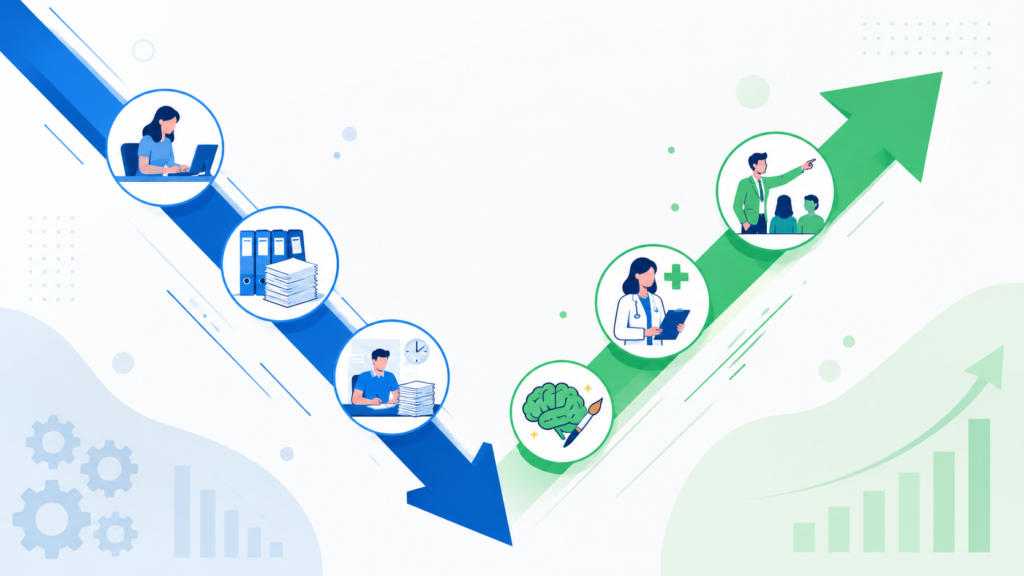
Many of the jobs disappearing or shrinking in 2026 share a few common characteristics: repetitive actions, predictable workflows, and limited need for human judgment. Once a task can be reduced to a clear, repeatable pattern, AI tends to take it over quickly and completely.
Data entry roles are one of the clearest examples. AI systems can input, verify, and organize data far faster and with fewer errors than a human team ever could. Administrative tasks like scheduling, invoice processing, and document sorting are also increasingly automated, which reduces the need for large support teams to handle routine paperwork.
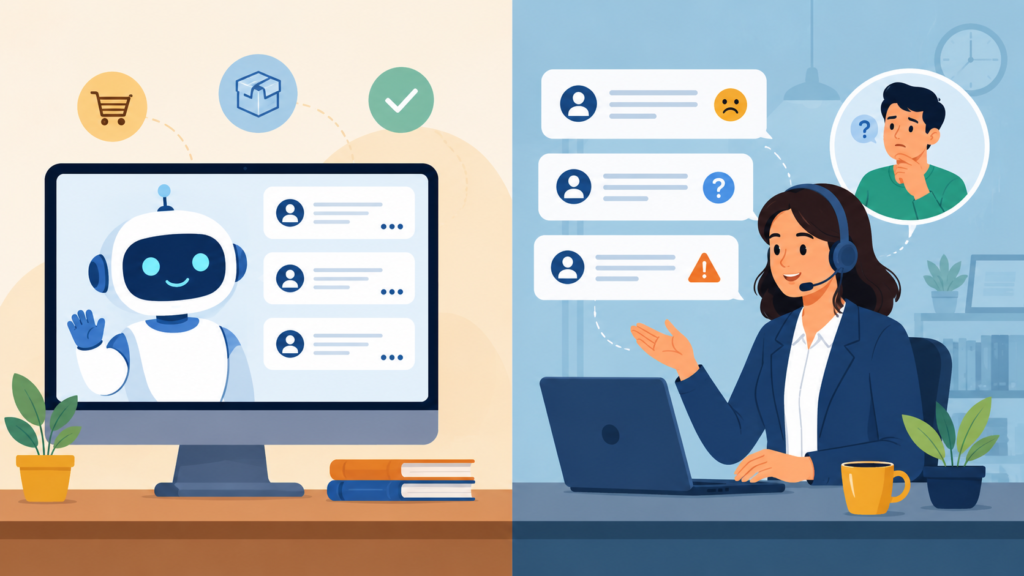
Customer service is another area going through significant change. AI chatbots and voice assistants now handle basic queries, order tracking, and routine complaints without any human involvement at all. That doesn’t mean customer service jobs are disappearing entirely, but the nature of the work has clearly shifted. Humans now focus on escalations, emotionally charged conversations, and complex edge cases, while AI absorbs the sheer volume and speed of everyday requests. As a result, fewer agents are needed overall, but the ones who remain need noticeably stronger communication and problem-solving skills than before.
Content creation has been affected in a similar way. AI can now generate blog drafts, social media captions, and marketing copy in seconds, which has reduced demand for low-skill, high-volume writing work. That said, human writers are far from obsolete. Original storytelling, opinion pieces, investigative journalism, and genuine brand voice development still rely heavily on human creativity, judgment, and lived experience, qualities AI can imitate on the surface but not truly originate. AI assists with the heavy lifting, but humans still decide what the content actually means and where it should go.
Entry-level coding and software testing roles are changing too. AI can generate boilerplate code, spot bugs, and suggest fixes in a fraction of the time it would take a junior developer. This reduces the day-to-day workload for entry-level programmers, but it doesn’t eliminate the need for them outright. Developers who genuinely understand systems architecture and complex problem-solving continue to be highly valuable. It’s the developers who rely purely on basic syntax, without any deeper understanding of how systems actually work, who face the greatest risk of being replaced.
AI vs Human Jobs: Jobs That Are Growing or Becoming More Valuable
While some roles are shrinking, plenty of jobs are becoming more important, not less, in 2026. Creative professions are a clear example of this shift. Designers, filmmakers, writers, and artists are increasingly using AI as a tool rather than treating it as a threat. AI helps generate drafts, explore variations, and speed up experimentation, but humans still provide the vision, the emotion, and the cultural relevance that make creative work resonate. Creativity rooted in genuine human experience remains extremely difficult, arguably impossible, for a machine to fully replicate.
Jobs that require emotional intelligence are among the safest of all. Teachers, therapists, nurses, counselors, and social workers rely on empathy, trust, and authentic human connection to do their jobs well. AI can assist with lesson planning, diagnostics, or administrative overhead, but it cannot replace genuine emotional understanding between two people. In fact, as more of daily life moves into digital, impersonal interactions, human-centered roles like these are becoming even more valuable, not less.
Leadership and decision-making roles will also continue to survive and thrive. AI can analyze trends and generate recommendations, but it cannot take responsibility for the outcomes of those decisions. Managers, entrepreneurs, policymakers, and executives still have to weigh ethics, long-term consequences, and real human impact in ways no algorithm can be held accountable for. In 2026, effective leadership is less about controlling access to information (AI has made that nearly free) and more about guiding people through constant change with clarity, empathy, and trust.
Skilled trades and hands-on jobs remain remarkably resilient as well. Electricians, plumbers, mechanics, construction supervisors, and technicians all work in unpredictable physical environments that are genuinely difficult to automate. While robots and automation do exist in some of these spaces, they remain expensive, limited in scope, and difficult to deploy consistently across messy, real-world job sites. Human adaptability and hands-on problem-solving still outperform machines in nearly every one of these fields.
A completely new category of jobs is also emerging, roles that exist specifically because of AI’s rise. These include AI workflow managers, prompt specialists, human-in-the-loop reviewers, and AI ethics professionals. These workers exist to make sure AI systems operate correctly, fairly, and safely at scale. In 2026, simply knowing how to work effectively with AI has become a valuable, in-demand skill in its own right, regardless of your industry.
Jobs That Are Transforming, Not Disappearing
Many professions aren’t vanishing at all, they’re transforming into something different. Teachers now use AI to handle grading and routine content preparation, which frees up more time for mentoring, discussion, and one-on-one attention with students. Doctors use AI for diagnostics and data analysis but remain fully responsible for treatment decisions and direct patient care. Marketers lean on AI for analytics and campaign automation while shifting their own focus toward strategy and storytelling, the parts of the job AI still can’t do well. The common thread across all of these examples is collaboration, not replacement.
One of the biggest myths floating around is the idea that AI will eventually replace all humans across the board. This idea fundamentally misunderstands how intelligence actually works. AI predicts patterns based on the data it’s been trained on; humans understand context, meaning, and consequences in a way that goes far beyond pattern recognition. AI has no awareness, no personal values, and no real accountability for the outcomes it produces. Humans are still the ones who set goals, define ethical boundaries, and ultimately decide what outcomes actually matter. In 2026, the most successful professionals aren’t the ones competing against AI, they’re the ones who’ve learned how to guide it effectively toward better results.
The Skills That Matter Most Now
As the job market keeps evolving, skills increasingly matter more than degrees on paper. Critical thinking, creativity, communication, adaptability, and basic AI literacy are proving far more valuable than raw memorization ever was. Knowing how to ask the right questions and critically evaluate AI-generated output is quickly becoming a core professional skill across nearly every industry, not just tech. Continuous learning is no longer optional, it’s essential just to stay relevant.
For students, preparing for the future means focusing on problem-solving, collaboration, and interdisciplinary learning rather than narrow, single-track specialization. AI can provide raw information instantly, but humans still have to interpret it, apply it to real situations, and know when to challenge it. Careers built on genuine curiosity and flexibility tend to hold up far better over time than careers built around rigid, repetitive routines.
For working professionals already established in their careers, future-proofing means embracing change rather than resisting it out of habit or fear. Learning the AI tools relevant to your specific field, shifting your day-to-day focus toward more strategic work, and deliberately strengthening distinctly human skills can all make a career meaningfully more secure. AI tends to reward the professionals who evolve alongside it, and it tends to leave behind the ones who simply hope it goes away.
Ethical Considerations Employers and Workers Should Watch
Ethical concerns around AI remain genuinely important as this shift continues. As AI systems increasingly influence hiring decisions, lending approvals, healthcare recommendations, and education outcomes, humans have to remain accountable for the results. Bias, transparency, and data privacy are ongoing challenges that don’t disappear just because a system is labeled “AI-powered.” In 2026, the most responsible organizations make sure humans retain the final decision-making authority, using AI as a support tool rather than treating it as an unquestioned authority.
What a Typical 2026 Workplace Looks Like
A typical workplace in 2026 looks noticeably different from just a few years ago. AI quietly handles repetitive tasks in the background without much fanfare. Teams tend to be smaller, but considerably more efficient than before. Meetings run shorter and stay more focused, since AI can handle a lot of the prep work and follow-up notes automatically. Human effort is increasingly concentrated on creativity, judgment, and collaboration, the things machines still can’t reliably do. Productivity itself is increasingly measured by actual impact rather than hours logged at a desk.
Frequently Asked Questions
Will AI take over most jobs by 2026? No. AI is automating specific tasks within jobs, not eliminating entire professions wholesale. Roles built around repetitive, predictable work are shrinking, while roles built around judgment, empathy, and creativity are holding steady or growing.
Which jobs are most at risk from AI in 2026? Data entry, basic administrative support, routine customer service, and low-skill high-volume content writing are among the roles seeing the biggest reductions, since these tasks are highly repeatable and easy for AI systems to handle accurately.
Which jobs are considered the safest from AI automation? Roles built on emotional intelligence and trust, such as teachers, therapists, nurses, and counselors, tend to be the safest, along with leadership positions and skilled trades that require hands-on adaptability in unpredictable environments.
What skills should I learn to stay competitive in an AI-driven job market? Focus on critical thinking, communication, adaptability, and basic AI literacy, meaning the ability to use AI tools effectively and evaluate their output critically. These skills transfer across almost any industry and age far better than narrow technical knowledge alone.
Is it too late to future-proof my career? No. The professionals who adapt, even starting now, by learning relevant AI tools and shifting their focus toward higher-judgment work, consistently outperform those who wait and hope the shift passes them by. A post about “Sora 2 AI Video Generator: How to Create Realistic Videos“
Final Thoughts
So, what will actually survive in the AI vs human jobs debate? Humans will. Jobs will change, some will shrink or disappear entirely, many will transform into something new, and entirely new categories of work will keep emerging as they always have during major technological shifts. The future doesn’t belong to those who try to compete directly with AI on its own terms, it belongs to those who learn to work alongside it intelligently.
The real dividing line in 2026 isn’t between AI and humans at all, it’s between those who adapt and those who refuse to. AI is an extraordinarily powerful tool, but at the end of the day, that’s still exactly what it is: a tool. The human mind, with its creativity, empathy, and sense of responsibility, remains something no machine has managed to replicate, and that’s unlikely to change anytime soon.