
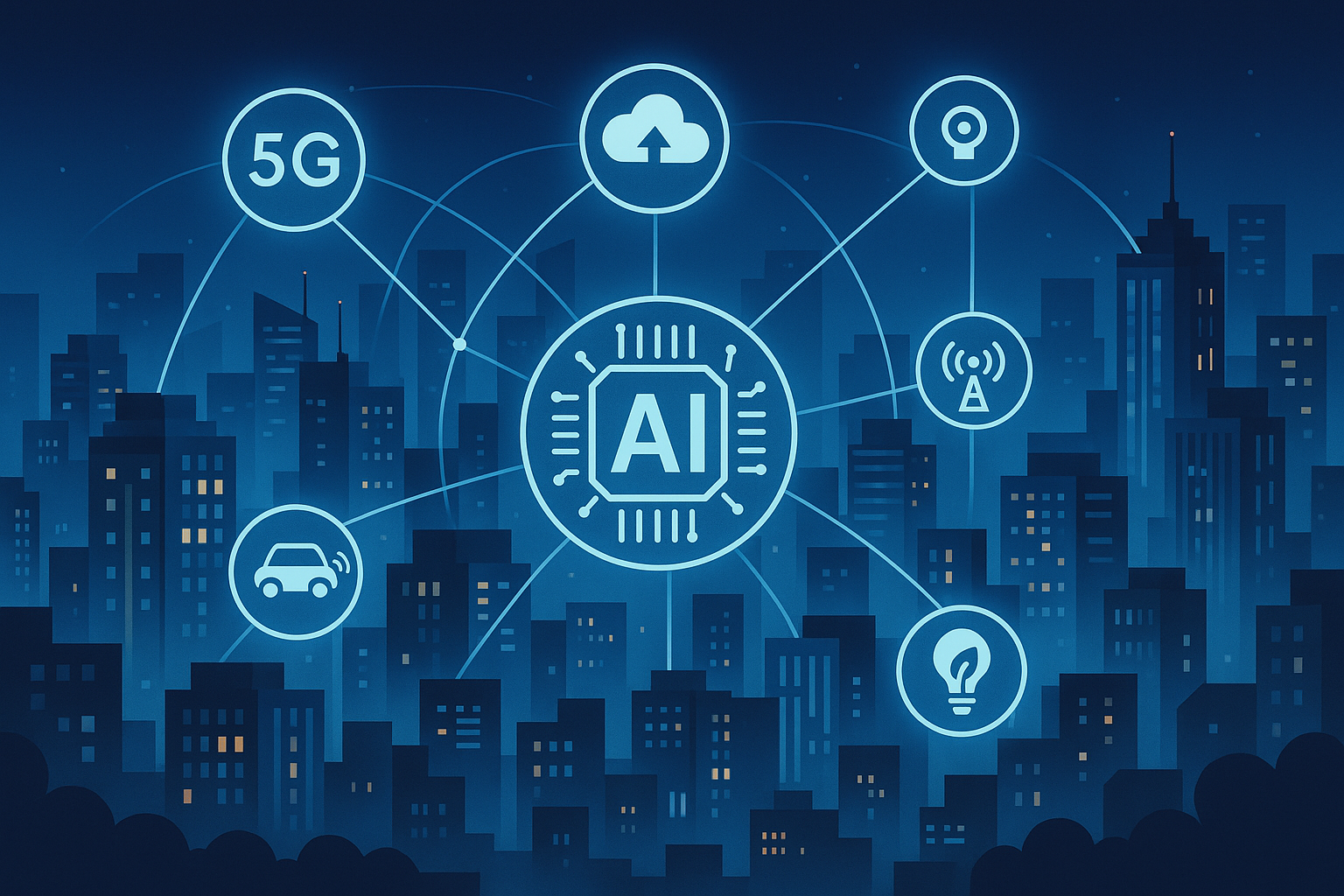
How 5G and AI Are Powering Smart Cities: The Future of Urban Innovation in 2025
Cities are changing fast, especially how we live and get around. This change is mostly thanks to 5G and AI. Both are big on their own, but together, they’re making cities smarter. These upgraded cities are more useful, cleaner, safer, and care more about the people who live there. Our world is getting more crowded, and more people are moving to cities, so we really need better city services. This blog looks at how 5G and AI are building the smart cities of the future, making city life easier and more connected.
Think of smart cities as places that use tech, gadgets, and smart systems to better daily life. They use a lot of info gathered from sensors, cameras, cars, buildings, and people. The point is to make city services work better—like getting around, healthcare, trash pickup, and keeping people safe. But, smart cities need fast internet and a way to understand all the data they collect. That’s where 5G and AI come in. 5G gives the speed needed to send tons of data, and AI looks at that data fast and turns it into useful stuff. When they’re together, cities can make quick choices, which is key to being a modern smart city.
First, let’s talk about 5G. Unlike 4G, 5G is made for a world where everything is online. It’s way faster, and there’s almost no delay when sending info. This is super important for things that need to happen right away, like self-driving cars, emergency services, and traffic lights that adjust themselves. Also, 5G can handle lots of devices in one area, so it’s perfect for cities with tons of sensors, lights, meters, and cameras. 5G makes sure everything in a smart city can talk to each other without problems because the connection is strong and fast.
AI is the other big thing making smart cities work. If 5G is the body’s nerves, AI is the brain. AI looks at all the data coming in every second. It finds patterns, guesses what will happen next, and makes choices automatically. For example, AI can guess when traffic will get bad and change traffic lights, control how much energy buildings use, check security cameras for anything strange, and watch health info from wearable gadgets. Sensors and devices can get data, but AI lets cities learn from that data and make smart choices. This helps cut down on mistakes, makes things work better, and generally improves how cities are run.
When 5G and AI team up, they make smart systems that work in real time. This changes how we get around cities the most. Usually, cities have traffic jams, long waits, and trips that are hard to plan. But with 5G sensors and AI models, traffic lights can change automatically based on how traffic is moving. Roads get safer because AI can spot accidents on cameras and tell the police right away. Self-driving cars, which are a big deal in smart cities, really need both 5G and AI. 5G lets these cars talk to each other and the traffic system instantly, and AI helps them drive, avoid crashes, and find their way safely.
How we get healthcare is changing a lot too, because of 5G and AI. In a smart city, you don’t have to be in a hospital to get medical help. People can wear devices that send info like heart rate and blood pressure to hospitals using 5G. AI looks at this info and warns doctors if something seems wrong. This helps doctors find problems early and treat them faster. In emergencies, ambulances connected to 5G can send info to the hospital before they even arrive, which saves time. In the future, doctors might even do surgeries from far away because 5G can send video smoothly and AI can help them during the surgery.
Smart cities need to save energy.
Regular power systems often have trouble guessing how much electricity people will use, which leads to shortages or waste. Smart systems powered by 5G and AI fix this by always checking how energy is being used. AI can guess when people will use more electricity and balance things out. Smart meters connected to 5G send updates to the system, making sure energy is used well. This helps save energy and lowers bills for homes and businesses. Renewable energy like solar and wind can also work better with AI models.
Keeping people safe is a big deal, and smart cities use 5G and AI to make things more secure. Cities now have lots of smart cameras that record video in high quality. These cameras use 5G to send video to control rooms instantly, where AI systems look at it in real time. AI can spot strange things, find accidents, track lost people, and warn the police right away. This makes the police respond much faster. Some cities use 5G drones to watch busy areas, check traffic, and help during emergencies. All of this makes public safety faster, smarter, and more useful.
Trash pickup and water use are also getting better. Old systems use schedules and people to check things, which isn’t always the best. With smart sensors connected by 5G, cities can see how full trash cans are or find water leaks right away. AI looks at this info and sends the best routes to trash trucks, saving gas and reducing pollution. It can also guess how much water people will use and help cities plan how to share water better. These changes make cities cleaner and help the environment.
Smart buildings are starting to be a common thing in cities.These buildings use AI to control the temperature, lights, security, and energy use automatically. Sensors see when people are in a room and change the lights or air conditioning. Facial recognition systems let people in without keys or cards. When connected to 5G, all of these systems talk to each other instantly, making things easy and automatic. This makes living better and saves a lot of energy.
Lots of cities are already using these technologies.
Singapore is viewed by many as one of the smartest cities, using AI to handle transportation, security, and energy. Barcelona uses smart sensors for trash pickup, saving gas and effort. New York is trying out AI traffic lights that talk to each other through 5G to cut down on traffic. Dubai has 5G police drones to help with security and emergencies. Tokyo uses AI in buildings to control elevators, lights, and cooling to save energy.
Smart cities powered by 5G and AI are very helpful. They make life better by making streets cleaner, transportation faster, and public services better. People are safer because security and emergency responses are faster and more accurate. Less energy is used, making cities greener. Businesses also gain from better infrastructure, which helps the economy and brings in new investments. Over time, smart cities become more self-sufficient, useful, and friendly.
But, changing to smart cities isn’t easy. One worry is privacy, because using lots of sensors and cameras could make people wonder about data security and their rights. Cybersecurity is another problem, because more devices connected means more chances for hackers. Building smart city infrastructure costs a lot, which some countries might struggle with. Also, handling huge amounts of data needs strong storage systems and skilled people. Governments need to work with tech companies to make sure 5G and AI are used safely and openly.
The future of smart cities looks good. In the coming years, we might see self-driving public transportation, AI energy grids, drones delivering things, and smart homes that talk to city systems in real time. Digital twins, which are like virtual copies of cities, will let planners test building projects, guess what disasters might happen, and manage resources better. City life will become more personal, useful, and sustainable.
In short, 5G and AI together are changing cities a lot. These technologies make a strong team that can guess what people need, fix problems fast, and improve life. As more cities use these ideas, city life will get better. The future of smart cities is already here, and they will only get smarter, greener, and more focused on people.
Also Check
FAQ 1: What is a smart city?
A smart city is an urban area that uses digital technology, connected sensors, 5G networks, and AI systems to improve transportation, energy usage, public safety, waste management, and overall living standards for citizens.
FAQ 2: How does 5G help in building smart cities?
5G provides ultra-fast speed, extremely low latency, and the ability to connect millions of devices. It enables real-time communication between sensors, vehicles, traffic systems, and AI platforms—making smart city automation possible.
FAQ 3: What role does AI play in smart cities?
AI analyzes data collected from millions of devices and makes intelligent decisions. It helps improve traffic flow, predict energy demand, enhance public safety, manage waste, and optimize city services.
FAQ 4: How do 5G and AI work together?
5G delivers instant communication between devices, while AI interprets this data and takes action. Together, they support real-time traffic management, autonomous vehicles, smart energy grids, and AI-driven surveillance.
FAQ 5: What are the benefits of smart cities using 5G and AI?
Smart cities become safer, cleaner, more energy-efficient, less congested, and technologically advanced. Residents enjoy better healthcare, improved public services, and enhanced quality of life.
FAQ 6: What challenges do smart cities face?
Smart cities face issues like privacy concerns, cybersecurity risks, high infrastructure costs, and the need for skilled professionals to manage advanced technologies like AI and 5G.
FAQ 7: What will smart cities look like in the future?
By 2035, smart cities will feature autonomous transportation, drone delivery systems, digital city twins, AI-managed energy grids, and fully connected homes that communicate with city infrastructure.